Publications
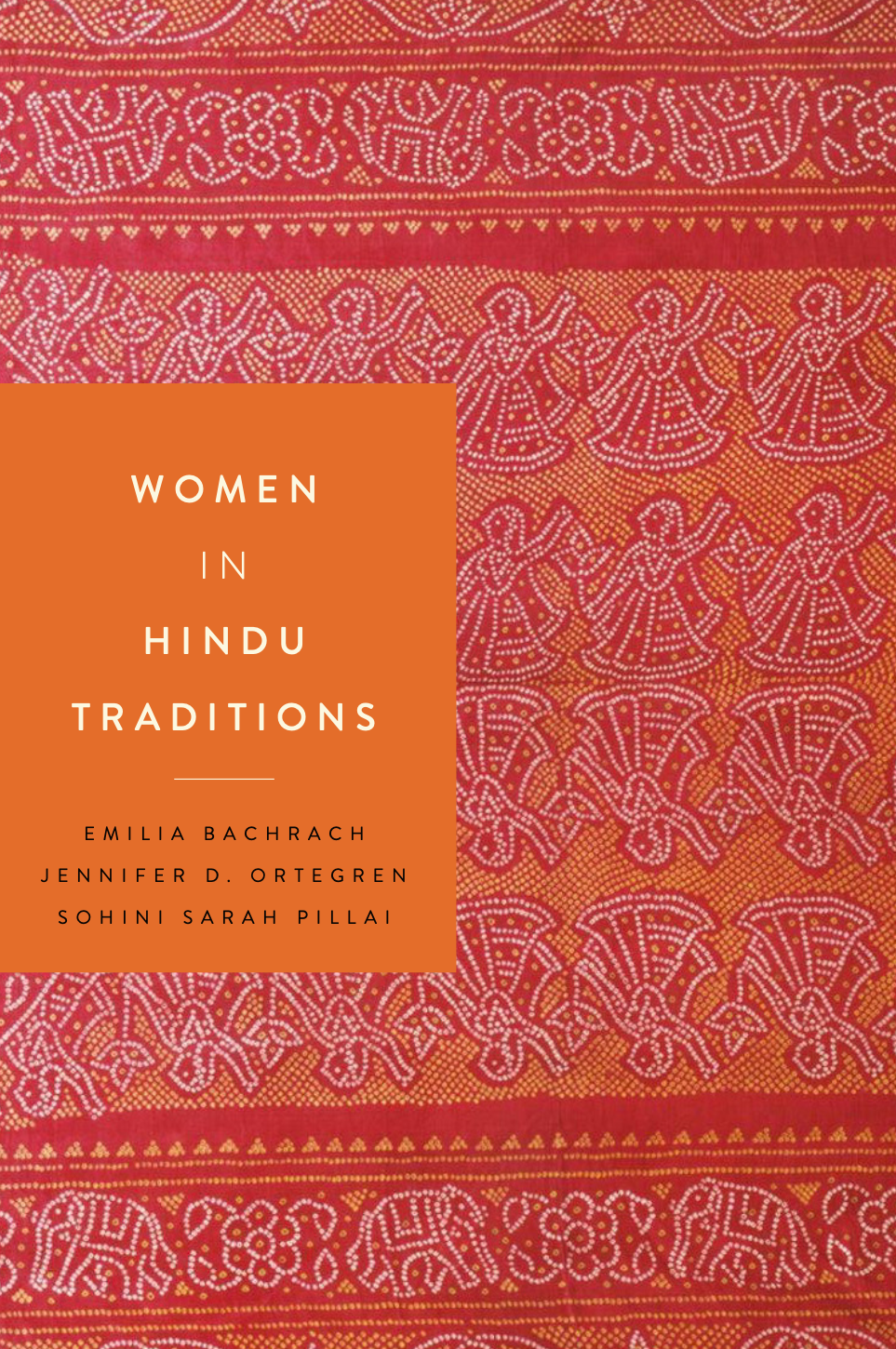
Women in Hindu Traditions
Co-authors: Emilia Bachrach and Jennifer D. Ortegren
Publisher: New York University Press (March 2027), Women in Religions series
Description: Women in Hindu Traditions showcases the centrality of women in the ritual and artistic traditions, religious institutions, and literature of Hindu traditions. It considers women's roles as everyday practitioners, gurus, epic protagonists, poet-saints, and performers across time and geography.
The volume shows that Hindu women have long reworked elite theologies, scriptures, and rituals in ways that may perpetuate, challenge, and/or innovate upon so-called normative traditions. In this vein, the book is careful to include discussions about Hindu women from various caste and class backgrounds in multiple regions of the Indian subcontinent, as well as the global diaspora.
In illuminating the many ways in which women are represented in and have contributed to Hindu traditions, Women in Hindu Traditions emphasizes the flexibility and fluidity of Hinduism more broadly. It discusses elite practices and texts—such as ancient Sanskrit narratives attributed to male authors—in conversation with vernacular texts and practices performed and authored by women in both historical and contemporary contexts. These discussions include an exploration of rituals that reveal women’s roles in domestic, public, and temple spaces in India and beyond, poem-songs in devotion to various gods and goddesses, and different iterations of female-authored epics, such as retellings of the Ramayana and Mahabharata.
Women in Hindu Traditions displays the incredible multiplicity of Hindu traditions, arguing for the value of comprehending religious traditions through women’s narratives and lives.
Praise for Women in Hindu Traditions:
“Offers an innovative, accessible examination of women’s contributions to Hindu traditions across historical and geographical contexts. Integrating diverse sources—religious texts, rituals, artistic representations, and everyday practice—it reorients the field by centering women’s voices, prompting a critical, self-reflexive approach to the study of religion.”
– Harshita Mruthinti Kamath, author of Impersonations: The Artifice of Brahmin Masculinity in South Indian Dance.
“Drawing on the expertise of each of its co-authors, Women in Hindu Traditions is a welcomed interdisciplinary textbook that incorporates ethnographic, textual, and media studies. Importantly, it includes Hindu women’s experiences, leadership, and television representation in North America. The book models the ways in which the answers to questions about women in Hindu traditions are shaped by who is asking and answering them and thus will be multiple and shifting according to social and historical contexts..”
– Joyce Burkhalter Flueckiger, Professor Emerit of Religion at Emory University.
“These authors turn the conventional textbook approach to Hinduism on its head. And that’s good! To disrupt millennia of male-centered religious histories, practices, concepts and categories, they have to surprise, disorient, and refresh both new readers and experts. Starting with women-centered rituals instead of ancient texts; spotlighting Hindu women in diaspora, which is where most students can meet them; centering women poets in devotional worlds; tacking deftly between traditional epics and the creative ways in which women have tackled their presentation of gender, caste, and class; and writing the whole book collaboratively! Students, teachers, women, men, gender nonconforming, and all who want to learn about Hinduism will do well to read and reflect on this book.”
– Linda Hess, author of Bodies of Song: Kabir Oral Traditions and Performative Worlds in North India
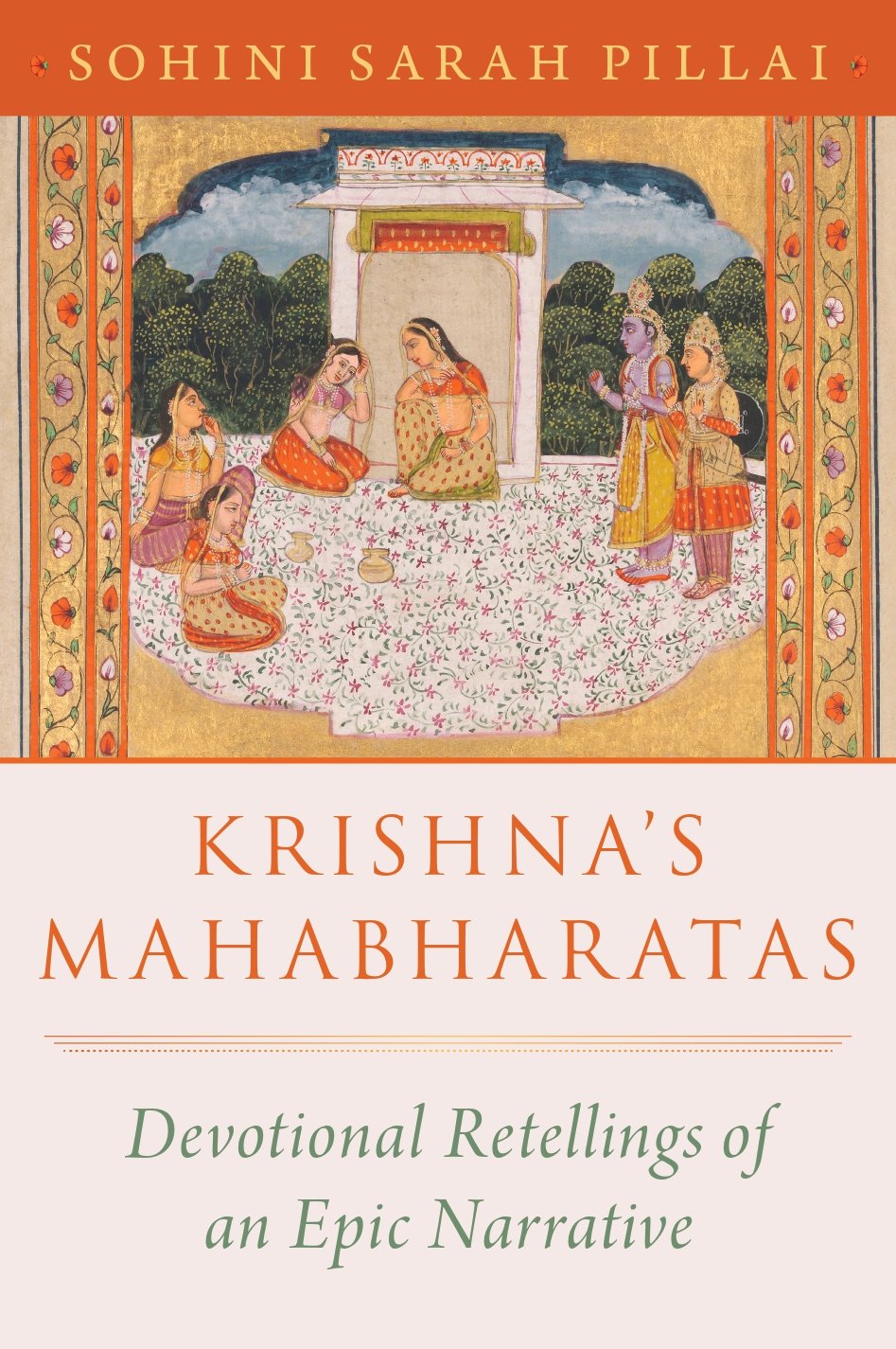
Publisher: Oxford University Press (2024), American Academy of Religion’s Religion in Translation series
Description: Recognized as the longest poem ever composed, the ancient Sanskrit Mahabharata epic tells the tale of the five Pandava princes and the cataclysmic battle they wage with their one hundred cousins, the Kauravas. This story is one of the most popular and widely-told narratives in South Asia, let alone the world. Between 800 and 1700 CE, a plethora of Mahabharatas were created in Assamese, Bengali, Gujarati, Hindi, Kannada, Konkani, Malayalam, Marathi, Oriya, Tamil, Telugu, and several other regional South Asian languages.
Krishna’s Mahabharatas: Devotional Retellings of an Epic Narrative is a comprehensive study of premodern regional Mahabharata retellings. This book argues that Vaishnavas (devotees of the Hindu god Vishnu and his various forms) throughout South Asia turned this epic about an apocalyptic, bloody war into works of ardent bhakti or “devotion” focused on the beloved Hindu deity Krishna. Examining over forty retellings in eleven different regional South Asian languages composed over a period of nine hundred years, it focuses on two particular Mahabharatas: Villiputturar’s fifteenth-century Tamil Paratam and Sabalsingh Chauhan’s seventeenth-century Bhasha (Old Hindi) Mahabharat.
Through close comparative readings, this book reveals the similar ways poets from opposite ends of the Indian sub-continent transform the story of the Sanskrit Mahabharata into devotional narratives centered on Krishna. At the same time, it also shows how these Mahabharatas are each unique pieces of religious literature that speak to different local audiences in premodern South Asia.
Praise for Krishna’s Mahabharatas:
“An empirically rich and detailed study of regional Mahabharatas, Sohini Pillai’s Krishna’s Mahabharatas is a major contribution to scholarship on Hindu epic and devotional traditions. Bringing together two understudied texts composed in Tamil and Bhasha, Pillai traces the growing devotional emphasis given to the figure of Krishna in regional Mahabharatas, reshaping how we view the project of vernacularization and the growth of bhakti in the second millennium.”
–Harshita Mruthinti Kamath, Visweswara Rao and Sita Koppaka Associate Professor in Telugu Culture, Literature, and History, Emory University.
“Sohini Pillai boldly tackles the complexities of the unruly epic’s chaotic development over millennia, and even more daunting, its ever-expanding retellings. She masterfully juggles the broad perspective with an acute eye for detail. At the heart of the work is a comparison between a Tamil and a Hindi retelling, influential respectively in contemporary performances in Tamil Nadu in South India and Chhattisgarh in the North, including by Dalit groups. Written engagingly in a broadly accessible way, the book also offers selections from a number of lesser-known retellings to delight the connoisseur.”
– Heidi R. M. Pauwels, Professor of Asian Languages and Literature, University of Washington.
“In Krishna’s Mahabharatas Sohini Pillai takes the trajectory of bhakti as it winds its way through the sub-continent seriously, and examines its narrative path in very different geographical locations and languages, revealing its shared landscape, thus helping us theorize bhakti from the ground up in ways which have not been attempted before. This is a work of meticulous and deeply original, textual scholarship and a fitting successor to the work of those such as Friedhelm Hardy, showing us the pan-Indian shared literary landscape and tropes of Krishna-ite devotion, much after the Bhagavatapurana.”
– Srilata Raman, Professor of Hinduism, University of Toronto.
“Scholars of Sanskrit epics and devotional literature will welcome Sohini Pillai’s insightful book which illuminates the epic’s richness by analyzing Villiputturar’sTamil Paratam and Chauhan’s Bhasha Mahabharat. She breaks down the rigid boundaries that separate South and North Indian bhakti texts by documenting the mythological, episodic, and rhetorical strategies that both poets deployed to transform a gruesome tale of war into a celebration of Krishna.”
– Paula Richman, Danforth Professor of South Asian Religions, Emerita, Oberlin College.
Krishna’s Mahabharatas: Devotional Retellings of an Epic Narrative

Many Mahabharatas
Co-editor: Nell Shapiro Hawley
Contributors: Amanda Culp, Eva De Clercq, David Gitomer, Robert Goldman, Sally J. Sutherland Goldman, Sudha Gopalakrishnan, Nell Shapiro Hawley, Harshita Mruthinti Kamath, Sucheta Kanjilal, Sudipta Kaviraj, Timothy Lorndale, Pamela Lothspeich, Philip Lutgendorf, Lawrence McCrea, Ahona Panda, Heidi Pauwels, Sohini Sarah Pillai, Paula Richman, and Simon Winant.
US Publisher: State University of New York Press (2021), SUNY series in Hindu Studies
Indian Publisher: Primus Books (2023)
Description: Many Mahabharatas is an introduction to the spectacular and long-lived diversity of Mahabharata literature in South Asia. This diversity begins with the Sanskrit Mahabharata, an early epic poem that narrates the events of a catastrophic fratricidal war. Along the way, it draws in nearly everything else in Hindu mythology, philosophy, and story literature. The magnitude of its scope and the relentless complexity of its worldview primed the Mahabharata for uncountable tellings in South Asia and beyond. For two thousand years, the instinctive approach to the Mahabharata has been not to consume it but to create it anew.
The many Mahabharatas of this book come from the first century to the twenty-first. They are composed in ten different languages—Apabhramsha, Bengali, English, Hindi, Kannada, Malayalam, Oriya, Sanskrit, Tamil, and Telugu. Early chapters illuminate themes of retelling within the Sanskrit Mahabharata itself, demonstrating that the story’s propensity for regeneration emerges from within. The majority of the book, however, reaches far beyond the Sanskrit epic. Readers dive into classical dramas, premodern vernacular poems, regional performance traditions, commentaries, graphic novels, political essays, novels, and contemporary theater productions—all of them Mahabharatas.
Because of its historical and linguistic breadth, its commitment to primary sources, and its exploration of multiplicity and diversity as essential features of the Mahabharata’s long life in South Asia, Many Mahabharatas constitutes a major contribution to the study of South Asian literature and offers a landmark view of the field of Mahabharata studies.
Reviews of Many Mahabharatas:
“Editors Hawley and Pillai perform a great service by assembling their own and seventeen other essays on different facets of a major Indian classic, one that resonates not only in today’s India but echoes in the debates and struggles of other actors in world affairs.”– Asian Perspective.
“Overall, the anthology is an excellent read. It thoroughly enriches and updates the field of Mahabharata Studies. This is a groundbreaking volume assembling a range of eminent scholarship.”– Religious Studies Review.
“All in all, the book offers readers an indispensable insight into the many perspectives and possible reading of the MBh [Mahabharata] as viewed through the prism of non- Sanskrit, vernacular and local versions.”– Journal of South Asian Languages and Linguistics.
“Many Mahabharatas is aimed at specialists in the epic, who will appreciate this volume’s inclusion of new voices alongside established ones, its expansion of disciplinary perspectives, and the satisfying continuities that unite the essays, making the whole greater than the sum of its parts.”– Reading Religion.
Journal Articles
“Remembering and Removing Aurangzeb: The Manuscript History of Sabalsingh Chauhan’s Mahabharat.” Comparative Studies of South Asia, Africa, and the Middle East 42, no. 2 (2022): 356–61. https://doi.org/10.1215/1089201X-9987827.
“The Mahabharata as Krsnacarita: Draupadi’s Prayer in Two Regional Retellings.” The Journal of Hindu Studies 14, no. 3(2021): 259–78. https://doi.org/10.1093/jhs/hiaa016.
Book Chapters
“The ‘Hindu’ Epics? Telling the Ramayana and the Mahabharata in Premodern South Asia.” In The Epic World, edited by Pamela Lothspeich. Routledge, 2024.
“Blessed Beginnings: Invoking Visnu, Krsna, and Rama in Two Regional Mahabharatas.” In Many Mahabharatas, edited by Nell Shapiro Hawley and Sohini Sarah Pillai. State University of New York Press, 2021.
Co-author with Nell Shapiro Hawley. “An Introduction to the Literature of the Mahabharata.” In Many Mahabharatas, edited by Nell Shapiro Hawley and Sohini Sarah Pillai. State University of New York Press, 2021.
“From Villainess to Victim: Contemporary Representations of Surpanakha.” In Oral-Written-Performed: The Ramayana Narratives in Indian Literature and Arts, edited by Danuta Stasik. CrossAsia eBooks, 2020.
“Challenging Religious Communalism with Theatre: Mahesh Dattani’s Final Solutions.” In The Theatre of Mahesh Dattani, edited by Mohini Khot. Aadi Publications, 2015.
Book Reviews
“John Nemec, Brahmins and Kings: Royal Counsel in the Sanskrit Narrative Literatures (Oxford University Press, 2025).” Reading Religion. January 31, 2026. https://readingreligion.org/9780197791998/brahmins-and-kings/.
“Ajay Gehlawat, Bollypolitics: Popular Hindi Cinema and Hindutva (Bloomsbury Academic, 2024).” South Asian History and Culture 16, no. 4 (2025): 482–84. https://doi.org/10.1080/19472498.2025.2552019.
“Review Essay: Discussing Hindu Studies from the Inside Out.” Co-author with Divya Cherian, Steven E. Lindquist, & Anna Lise Seastrand. Religious Studies Review 51, no. 2 (2025): 373–85. https://doi.org/10.1111/rsr.17918.
“Ruth Vanita, The Dharma of Justice in the Sanskrit Epics: Debates on Gender, Varna, and Species (Oxford University Press, 2022).” The Journal of Religion 104, no. 1 (2024): 120–21. https://doi.org/10.1086/727615.
“Literature and Modernity: A Review of Sudipta Kaviraj’s The Invention of Private Life.” Baraza. 2015. https://baraza.cdrs.columbia.edu/literature-and-modernity-a-review-of-sudipta-kavirajs-the-invention-of-private-life/.